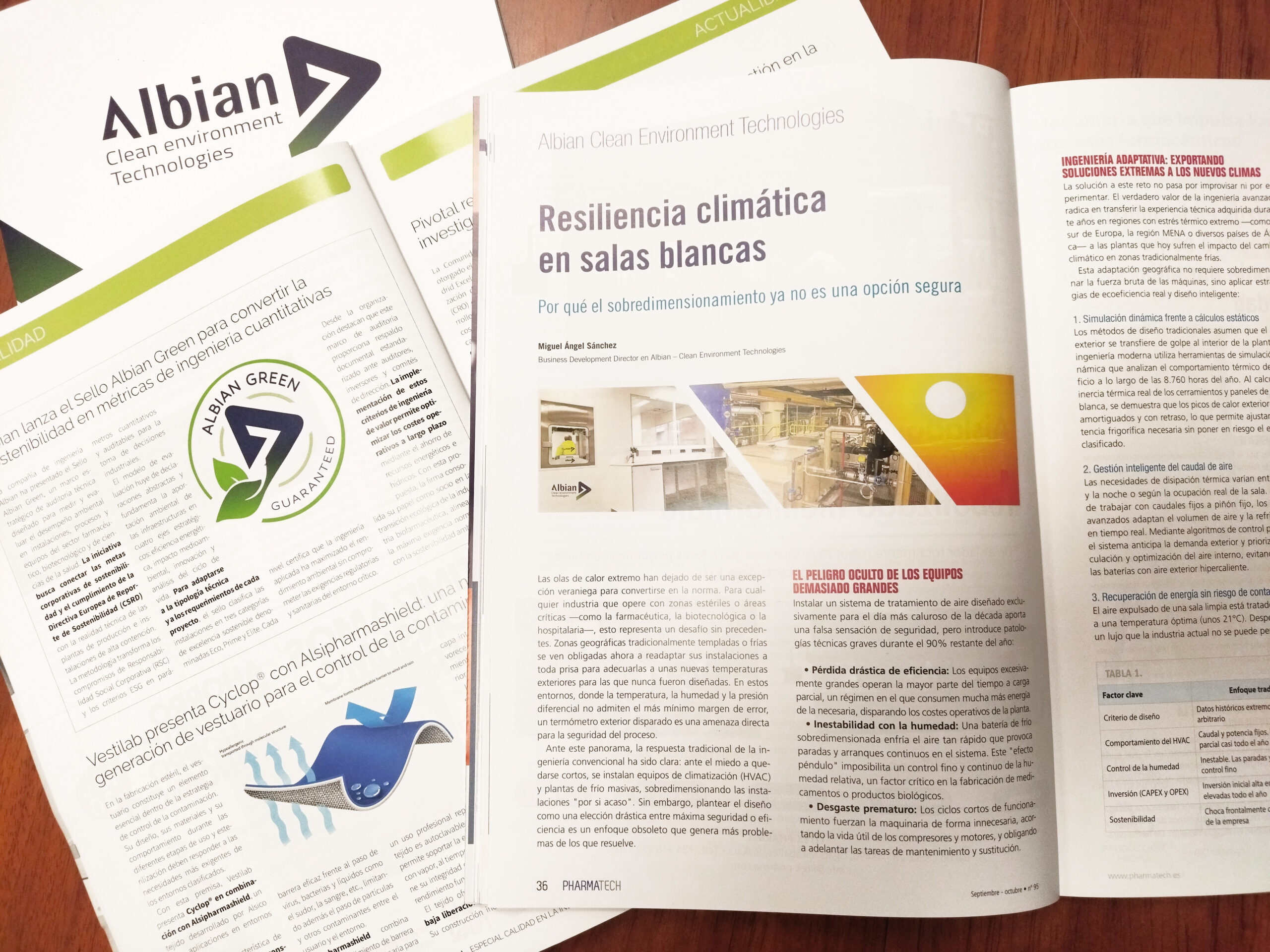
On October 26, 2026, the specialized magazine Pharmatech published a technical article written by Miguel Ángel Sánchez, Business Development Director at Albian, analyzing how to adapt the design of critical environments to rising extreme temperatures without compromising energy efficiency.
We are echoing the recent publication by our colleague Miguel Ángel Sánchez on the Pharmatech portal, titled “Resiliencia climática en salas blancas: por qué el sobredimensionamiento ya no es una opción segura” (Climate resilience in cleanrooms: why oversizing is no longer a safe option). In a context where extreme heatwaves are forcing pharmaceutical, biotechnological, and hospital facilities in traditionally temperate or cold regions to retrofit their installations, remembering and analyzing this approach is essential to ensure operational continuity and sustainability in the sector.
The article debunks the common conventional engineering practice of oversizing HVAC systems and chiller plants “just in case.” Far from providing greater safety, excessively large equipment creates severe inefficiencies during 90% of the year: it drives up electricity consumption by operating at partial load, causes instability in relative humidity control due to the “pendulum effect,” and accelerates machinery wear and tear.
Faced with this strategy, at Albian we advocate for adaptive engineering, transferring our experience from projects developed in regions with extreme thermal stress (such as Southern Europe, the MENA region, or Africa) to environments that today face new climate challenges. Among the key solutions highlighted in the publication are:
- Dynamic simulation: Analyzing the actual thermal behavior of the building throughout the 8,760 hours of the year to adjust cooling capacity to the real thermal inertia of the enclosures.
- Intelligent airflow management: Applying predictive control algorithms that regulate cooling and recirculation in real time based on demand.
- Safe energy recovery: Integrating run-around coil systems (separated double-coil loops) that use exhausted conditioned air to pre-cool incoming outside air, with zero risk of cross-contamination.
With this approach, it is possible to achieve energy savings of up to 35% while maintaining maximum environmental stability, demonstrating that process safety and decarbonization are fully compatible goals.
👉 You can read the full technical article published on October 26 in Pharmatech here: Resiliencia climática en salas blancas: por qué el sobredimensionamiento ya no es una opción segura (in Spanish)