On March 12, 2025, the journal Nature published a game-changing study in the fight against malaria: “Gene-drive-capable mosquitoes suppress patient-derived malaria in Tanzania.” Today, at Albian, we are revisiting this milestone to highlight the critical infrastructure that made it possible. We believe in the importance of documenting the technical excellence behind such projects, honoring the breakthroughs that represent a “before and after” in global health.
The publication of this study marks a historic turning point: the use of gene-drive mosquitoes to suppress malaria under real-world conditions. This clinical advancement would have been impossible without high-security containment infrastructure capable of bringing cutting-edge research directly to the heart of Africa.
Scientific Milestones: The True Engine of the Project
Beyond the physical structure, this achievement represents a paradigm shift in malaria control:
- Efficacy with Real-World Parasites: For the first time, it was proven that genetically modified mosquitoes can block malaria parasites extracted directly from patients in Tanzania, far surpassing conventional laboratory testing.
- Gene-Drive Technology: This approach allows malaria-resistance traits to spread rapidly through wild populations, offering a sustainable, long-term solution.
- Scientific Sovereignty in Africa: Led and executed at the Ifakara Health Institute (IHI), this research proves that with the right resources, local talent is the primary driver of change.
Who built the high-containment laboratory used in the Nature study?
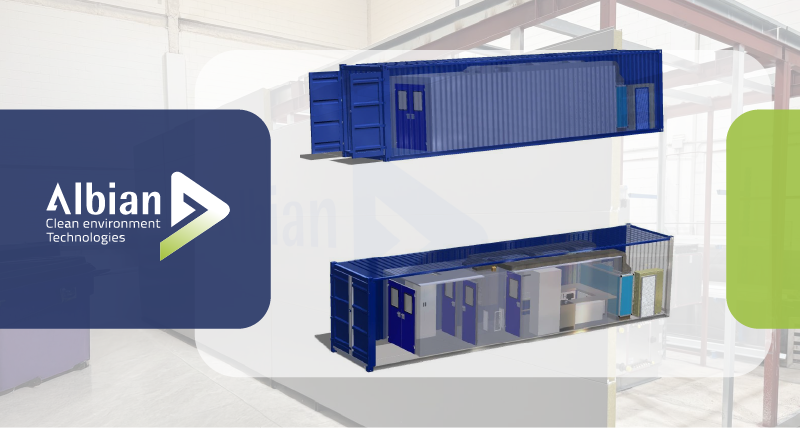
Albian fully designed and manufactured the MPL/CL3 (Modular Portable Laboratory) in Spain—a Level 3 biocontainment facility transported to the Ifakara Health Institute (IHI) Bagamoyo campus. This infrastructure was the cornerstone of the project’s success, integrating the most stringent industrial standards.
The Modular Infrastructure (MPL/CL3) as a Critical Enabler: Key Project Features
For these scientific advances to move from theory to reality in an African context, safety and technical rigor were non-negotiable. The MPL/CL3 developed by Albian provided the necessary guarantees for success.
The study describes a facility specifically designed to overcome logistical and regulatory constraints in remote environments. Albian’s modular solution integrates world-class standards.
How does modular architecture empower biotechnological research?
The challenge of this project was as much logistical as it was scientific. Gene-drive research requires total, infallible isolation. Our modular solution achieved three fundamental goals:
- Global Standardization: A laboratory environment with the same quality and precision as any elite European center, located at the epicenter of the crisis.
- Operational Agility: Drastic reduction in civil works and on-site commissioning times, allowing research to begin without delay.
- Auditable Security: Providing Tanzanian authorities with a secure, high-tech environment to approve and oversee trials involving modified organisms.
Conclusion: Technological Sovereignty at the Service of Life
Sharing this news serves as a reminder of why we do what we do. At Albian, we understand that our engineering is the foundation upon which tomorrow’s medical milestones are built. Partnering with world-class institutions on this project reinforces our commitment to innovation. By providing standardized, secure environments, we ensure that elite science can reach the places where it is needed most.
We design the spaces where the future of medicine is built.
🔗 Original Reference: You can read the full study published in Nature on March 12, 2025: “Gene-drive-capable mosquitoes suppress patient-derived malaria in Tanzania”